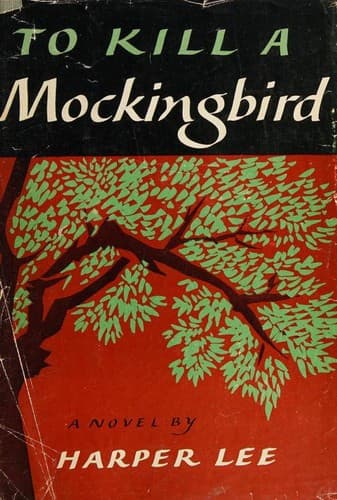
To Kill a Mockingbird (1960)
About This Book
In a small Alabama town during the Depression, a lawyer named Atticus Finch defends a Black man falsely accused of raping a white woman, and the story is told through the eyes of his six year old daughter Scout, whose innocence provides a lens through which the town's racism, courage, and complexity are refracted with devastating clarity. Harper Lee wrote the novel that shaped how America thinks about justice, empathy, and moral courage.
Why It's a Classic
Lee's narrative strategy of filtering the story through Scout's perspective is the novel's most powerful device: Scout sees everything but understands only part of it, and the gap between her perception and the reader's comprehension creates a dramatic irony that makes the novel's themes feel discovered rather than taught. Atticus Finch became the moral ideal for an entire generation of lawyers and citizens, a man who does the right thing not because it will succeed but because it must be done, and his instruction to Scout that you cannot truly understand someone 'until you climb into his skin and walk around in it' is the novel's definition of empathy. Boo Radley's story, which runs parallel to the trial, transforms from a childhood ghost story into a meditation on how we fear what we do not understand. The trial itself, in which the evidence clearly exonerates Tom Robinson and the jury convicts him anyway, is one of the most powerful depictions of structural racism in American fiction. The novel won the Pulitzer Prize and has sold over forty million copies.
Fun Fact
Lee based Atticus Finch on her own father, Amasa Coleman Lee, a lawyer in Monroeville, Alabama, who once defended two Black men accused of murder. Her childhood friend and neighbor was Truman Capote, who is the basis for the character of Dill Harris. Lee accompanied Capote to Kansas to research In Cold Blood, but their friendship deteriorated over the years. She never published another novel during her lifetime (Go Set a Watchman, a draft that preceded Mockingbird, was published controversially in 2015). The novel has been one of the most frequently challenged books in American schools, with objections ranging from its racial language to its treatment of rape.
Parent Note
The novel contains racial slurs (the N-word appears multiple times), a false accusation of rape, a trial in which injustice prevails, the shooting death of a character, domestic abuse, and the killing of a man by another character that is covered up. The racial language reflects the 1930s Deep South setting and is used to depict rather than endorse racism. The novel's perspective is that of a white family, and recent critics have noted its limitations in centering white heroism in a story about Black suffering. The prose is accessible and the novel is roughly 280 pages. Suitable for readers thirteen and up. One of the most widely read and taught novels in American literature.
Quick Facts
- Year
- 1960
- Type
- 📚 Book
- Category
- Modern & Contemporary Literature
- Age Group
- Adults (Ages 18+)