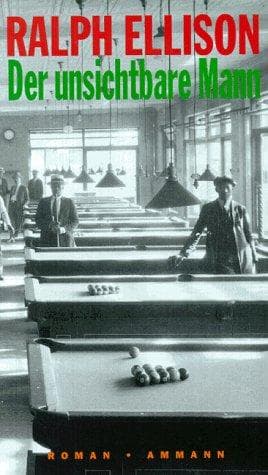
Invisible Man (1952)
About This Book
An unnamed Black man narrates his journey from a Southern college through Harlem to an underground room illuminated by 1,369 light bulbs, and along the way he is manipulated by white benefactors, exploited by Black nationalists, used by communists, and rendered invisible not by a scientific experiment but by a society that refuses to see him as an individual. Ralph Ellison wrote the most ambitious and innovative American novel of the twentieth century.
Why It's a Classic
Ellison's narrator is 'invisible' because other people see only their own projections, stereotypes, and needs when they look at him, and the novel catalogs these failures of perception with a range of styles, from naturalism to surrealism to jazz improvisation, that mirrors the narrator's search for a form adequate to his experience. The 'Battle Royal' opening, in which Black students are forced to fight blindfolded for the entertainment of white civic leaders, is one of the most searing scenes in American literature, establishing immediately the connection between entertainment and dehumanization. The novel's structure, which moves through institutions (the college, the factory, the Brotherhood) that each promise identity and deliver exploitation, systematically dismantles every available narrative of Black advancement, leaving the narrator alone in his basement with his stolen electricity and his voice. Ellison's prose draws on jazz: it riffs, improvises, doubles back, and builds to climaxes that resolve in unexpected keys, and this formal ambition makes the novel one of the rare works that is both politically urgent and artistically revolutionary.
Fun Fact
Ellison worked on the novel for seven years, from 1945 to 1952, and drew on his experiences growing up in Oklahoma City, attending Tuskegee Institute in Alabama, and living in Harlem. He was a trained jazz musician, and the novel's structure reflects jazz composition principles, particularly the tension between improvisation and structure. The novel won the National Book Award in 1953, making Ellison the first Black writer to receive the prize. He spent the rest of his life working on a second novel that was never completed (a version, 'Juneteenth,' was published posthumously in 1999). The 1,369 light bulbs in the narrator's underground room are powered by illegally tapped electricity from Monopolated Light and Power, a metaphor for the narrator's relationship to American power: excluded from its legitimate benefits, he takes what he needs by subversive means.
Parent Note
The novel contains racial violence (the Battle Royal, police brutality, a race riot), psychological manipulation, sexual content (including a scene involving a white woman and racial fetishism), political exploitation, and the sustained trauma of living in a racist society. The violence is sometimes surreal (the factory hospital scene) and sometimes brutally realistic. Racial slurs are used by characters reflecting the mid-twentieth century setting. The novel's length (roughly 580 pages) and stylistic complexity require commitment. Suitable for readers seventeen and up. One of the essential novels in American literature.
Quick Facts
- Year
- 1952
- Type
- 📚 Book
- Category
- Modern & Contemporary Literature
- Age Group
- Adults (Ages 18+)