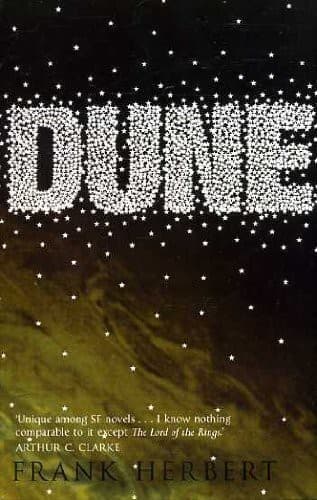
Dune (1965)
About This Book
A young nobleman is thrust into the politics, ecology, and religious fervor of a desert planet that produces the most valuable substance in the universe, and his journey from exile to messiah is both thrilling and deeply unsettling in its examination of how heroes become tyrants. Frank Herbert created science fiction's most intricate and fully realized world, a novel that rewards rereading the way few genre works ever do.
Why It's a Classic
Herbert wove together ecology, religion, politics, and psychology into a narrative so densely layered that readers have spent sixty years excavating its meanings. The planet Arrakis is science fiction's most complete creation: its sandworms, its water economy, its Fremen culture, and its spice cycle form an ecosystem so internally consistent that it functions as a genuine thought experiment about how environment shapes civilization. Paul Atreides' arc is a deliberate subversion of the chosen one narrative; Herbert designed Paul not as a hero to admire but as a warning about the dangers of following charismatic leaders, a theme that becomes explicit in the sequels. The Bene Gesserit, a sisterhood that has spent millennia manipulating bloodlines and planting religious myths to serve their long-term plans, anticipated real-world discussions about institutional power and social engineering decades before they became mainstream. The novel's influence extends far beyond literature: Star Wars, Game of Thrones, and countless other franchises bear its fingerprints.
Fun Fact
Herbert was inspired to write Dune after researching a USDA project to stabilize the Oregon Dunes using poverty grass, which led him to think about how humans interact with desert environments. The novel was rejected by over twenty publishers before being accepted by Chilton Books, a company better known for publishing automobile repair manuals. Herbert based the Fremen partly on Arab Bedouin cultures and T.E. Lawrence's experiences, though this cultural borrowing has received critical scrutiny in recent years. He spent six years researching and writing the novel, studying ecology, religion, and Middle Eastern history.
Parent Note
The novel contains political intrigue, betrayal, warfare, and death. There is drug use (the spice melange functions as both a consciousness expanding substance and an addictive resource). Themes of religious manipulation and messiah complex are central to the story. Violence is present but not gratuitously described. Sexual content is minimal. The prose is dense with invented terminology and requires attentive reading. Suitable for readers fifteen and up. The novel functions as an excellent gateway to more challenging science fiction.
Quick Facts
- Year
- 1965
- Type
- 📚 Book
- Category
- Fantasy / Sci-Fi
- Age Group
- Adults (Ages 18+)