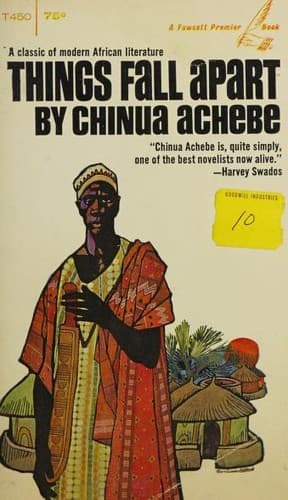
Things Fall Apart (1958)
About This Book
Okonkwo, a respected leader in an Igbo village in what is now Nigeria, has built his life on strength, hard work, and the fear of becoming like his gentle, unsuccessful father, and when European missionaries and colonial administrators arrive, his world and his sense of self collapse together. Chinua Achebe wrote the novel that gave Africa its own voice in world literature and answered, permanently, the question of who gets to tell Africa's story.
Why It's a Classic
Achebe's achievement was twofold: he depicted pre-colonial Igbo society in its full complexity, with its rituals, its justice system, its art, and its internal contradictions, refusing to present it as either a paradise or a primitive darkness, and he showed the destruction of that society by colonialism with a devastating clarity that Western novels about Africa had never attempted. Okonkwo is a tragic hero in the classical sense: his greatest strength (his determination never to show weakness) is also his fatal flaw, and the novel traces how a man who cannot bend is broken by forces that require adaptation. The novel's prose is deceptively simple, blending English with Igbo proverbs ('When the moon is shining the cripple becomes hungry for a walk') in a way that creates a narrative voice that feels authentically African without exoticizing itself. The novel was written explicitly in response to European literature about Africa, particularly Conrad's Heart of Darkness, and Achebe's depiction of a functioning, complex African civilization before colonialism is itself an act of cultural resistance.
Fun Fact
Achebe wrote the novel in English rather than Igbo, a decision he defended as pragmatic: English was the language that could reach the widest audience and challenge the very traditions that had used it to misrepresent Africa. The novel has sold over twelve million copies and has been translated into more than fifty languages, making it the most widely read African novel ever. Achebe was twenty-eight when it was published. He later became one of the most prominent critics of Heart of Darkness, arguing in a famous 1977 lecture that Conrad was 'a thoroughgoing racist' who used Africa as a backdrop for European psychological drama. The novel's title comes from W.B. Yeats' poem 'The Second Coming' ('Things fall apart; the centre cannot hold'), an ironic choice that places an African tragedy within a European literary framework.
Parent Note
The novel contains violence (including the killing of a child who calls the protagonist 'father,' a scene that is one of the most painful in the book), domestic violence, the ritual abandonment of twins in the forest (a cultural practice Achebe depicts without approval or condemnation), suicide, and the psychological destruction wrought by colonialism. The depiction of Igbo cultural practices includes some that modern readers will find disturbing. The prose is accessible and the novel is short (roughly 200 pages). Suitable for readers fifteen and up. Essential world literature and one of the most important novels of the twentieth century.
Quick Facts
- Year
- 1958
- Type
- 📚 Book
- Category
- Modern & Contemporary Literature
- Age Group
- Adults (Ages 18+)