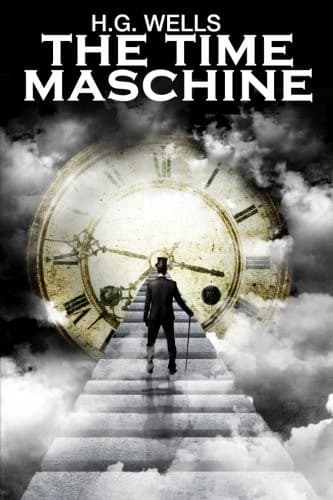
The Time Machine (1895)
About This Book
A Victorian inventor builds a machine that carries him to the year 802,701, where he discovers that humanity has split into two species: the childlike, helpless Eloi who live on the surface and the brutal, subterranean Morlocks who farm the Eloi for food. H.G. Wells wrote the first great time travel story and embedded within it a horrifying allegory about where the class divisions of his own era might lead.
Why It's a Classic
Wells took the Victorian class system to its logical evolutionary conclusion: the leisured upper classes, freed from all need to work or think, have devolved into the helpless Eloi, while the laboring classes, forced underground, have evolved into predatory Morlocks who literally consume the class that once exploited them. The allegory is savage and its implications uncomfortable: Wells is suggesting not that the poor will rise up in revolution but that both classes will be degraded by their respective positions until neither is recognizably human. The Time Traveller's journey further into the future, past the age of the Eloi and Morlocks to a dying Earth where giant crabs scuttle across a blood-red beach beneath a swollen sun, is one of the most haunting passages in science fiction, a vision of cosmic entropy that makes human concerns seem trivially brief. The novella's brevity (roughly 100 pages) is a strength: Wells says everything he needs to say and stops.
Fun Fact
Wells was a student of the biologist Thomas Henry Huxley (Aldous Huxley's grandfather), and his understanding of evolutionary theory directly informed the novel's central premise. The novella essentially invented the concept of the time machine as a vehicle, and the term 'time machine' entered the English language through this work. Wells wrote it at age twenty-nine, and it was his first novel. The story has been adapted into films multiple times, most famously in 1960 by George Pal, whose Morlock designs became the standard visual reference. The novella's vision of a far-future dying Earth influenced science fiction for over a century.
Parent Note
The novella contains scenes of violence between the Eloi and Morlocks, the implication that the Morlocks eat the Eloi (a form of cannibalism), and a vision of Earth's far future that is bleak and unsettling. The class allegory may require historical context about Victorian England. No sexual content or strong language. The prose is Victorian but clear and fast-paced. The novella is very short (roughly 100 pages) and highly accessible. Suitable for readers thirteen and up. An excellent introduction to both H.G. Wells and the science fiction genre, and a useful text for discussions about class, evolution, and the future of humanity.
Quick Facts
- Year
- 1895
- Type
- 📚 Book
- Category
- Fantasy / Sci-Fi
- Age Group
- Adults (Ages 18+)