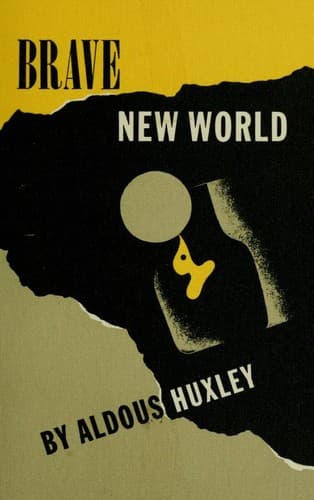
Brave New World (1932)
About This Book
In a future society where humans are genetically engineered into castes, conditioned from birth to accept their roles, and kept docile through a pleasure drug called soma, a 'savage' raised outside the system arrives and finds that happiness without freedom is no happiness at all. Aldous Huxley wrote a dystopia that turned out to be more prophetic than Orwell's: the danger was not that we would be oppressed but that we would be entertained into submission.
Why It's a Classic
Huxley's insight was that totalitarianism does not require jackboots and surveillance; it can be achieved through pleasure, distraction, and the elimination of anything that causes discomfort, including art, religion, genuine emotion, and the capacity for solitude. The World State has solved every problem that has ever plagued humanity (war, poverty, disease, unhappiness) and the cost is everything that makes human life meaningful. Bernard Marx, the misfit Alpha who senses something is wrong but lacks the courage or clarity to articulate it, is a more realistic portrait of dissent than most dystopian heroes: he wants to feel important, not to liberate anyone. John the Savage, raised on Shakespeare and Pueblo customs, provides the outsider perspective that exposes the World State's emptiness, but Huxley is honest enough to show that the alternative he offers (suffering, self-flagellation, and puritanism) is not a viable solution either. The novel refuses to provide a comfortable answer.
Fun Fact
Huxley was the grandson of Thomas Henry Huxley, the biologist known as 'Darwin's Bulldog' for his fierce advocacy of evolution, and the brother of Julian Huxley, a prominent biologist and eugenicist. This family background in biology directly influenced the novel's emphasis on genetic engineering and conditioning. Huxley wrote to Orwell after reading 1984, politely arguing that his own vision of the future was more likely to come true: tyranny through pleasure rather than pain. The drug soma takes its name from the ritual drink mentioned in the Vedas, the sacred texts of Hinduism. The novel's title comes from Miranda's speech in Shakespeare's The Tempest: 'O brave new world, that has such people in it.'
Parent Note
The novel contains references to promiscuous sexuality (presented as socially mandated), recreational drug use (soma), the industrial production and conditioning of human beings, and a disturbing climax involving self-flagellation and public spectacle. The casual attitude toward sex and the commodification of human bodies may be more disturbing to some readers than explicit content would be. There is a suicide at the novel's end. Language is mild. The novel is short (roughly 250 pages) and accessible. Suitable for readers fifteen and up. Pairs naturally with 1984 for discussions about different models of social control.
Quick Facts
- Year
- 1932
- Type
- 📚 Book
- Category
- Fantasy / Sci-Fi
- Age Group
- Adults (Ages 18+)