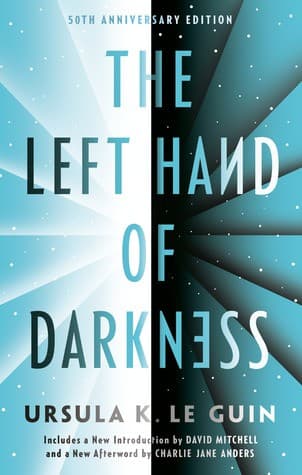
The Left Hand of Darkness (1969)
About This Book
An envoy from an interstellar collective arrives on a planet whose inhabitants have no permanent gender, shifting between male and female states during their reproductive cycle, and his attempt to understand this society while navigating a political crisis forces him to confront assumptions about identity that he did not even know he held. Ursula K. Le Guin wrote science fiction's most profound exploration of gender and otherness.
Why It's a Classic
Le Guin used the planet Gethen not as a thought experiment about biology but as a way of asking what human society would look like if the concept of gender were removed from its foundations: there is no division of labor by sex, no structural sexism, and no permanent sexual roles, and the envoy Genly Ai's struggle to perceive the Gethenians as fully human without gendering them reveals how deeply sex shapes perception. The central relationship between Ai and the Gethenian politician Estraven is one of science fiction's great partnerships, a bond that develops through shared hardship during a harrowing journey across a glacier and that transcends the categories either character would normally use to define intimacy. Le Guin's prose is precise and restrained, creating a world that feels physically real, from the bitter cold of Gethen's winter to the political maneuvering of its rival nations. The novel has been critiqued for defaulting to masculine pronouns for the Gethenians, a limitation Le Guin herself later acknowledged and attempted to address in subsequent work, which only deepens the conversation the novel opens.
Fun Fact
Le Guin later expressed regret about her use of male pronouns for the Gethenians, writing a revised version of a key chapter using feminine pronouns to demonstrate how differently it read. She also wrote a short story set on Gethen, 'Coming of Age in Karhide,' that addressed some of the limitations she perceived in the original novel. The novel won both the Hugo and Nebula Awards in 1970, one of the first books to achieve this double. Le Guin's father was the renowned anthropologist Alfred Kroeber, and her mother was the writer Theodora Kroeber, whose book 'Ishi in Two Worlds' influenced Le Guin's approach to depicting alien cultures with anthropological rigor rather than exoticizing them.
Parent Note
The novel contains political imprisonment, betrayal, death from exposure during a dangerous journey, and the psychological stress of being an outsider in an alien culture. The absence of fixed gender is handled thoughtfully and provides rich material for discussion. There is no explicit sexual content, though the Gethenian reproductive cycle (kemmer) is described. Some violence related to political conflict. The prose is accessible but intellectually demanding. Suitable for readers fifteen and up. An essential text for discussions about gender, identity, and cultural assumptions.
Quick Facts
- Year
- 1969
- Type
- 📚 Book
- Category
- Fantasy / Sci-Fi
- Age Group
- Adults (Ages 18+)