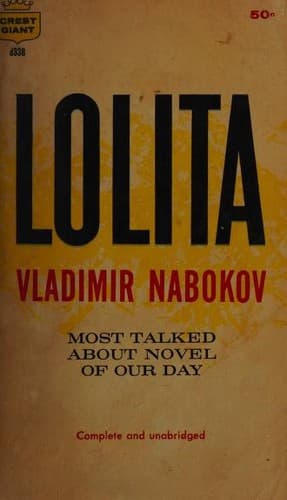
Lolita (1955)
About This Book
A middle-aged European professor named Humbert Humbert describes, in elaborate, seductive, and self-justifying prose, his obsession with a twelve year old American girl whom he calls Lolita, and the novel follows his manipulation, kidnapping, and sexual abuse of her across a nightmarish road trip through 1950s America. Vladimir Nabokov wrote the most controversial and one of the most beautifully written novels of the twentieth century, a work that forces the reader to confront the relationship between aesthetic beauty and moral horror.
Why It's a Classic
Nabokov's central achievement is making Humbert's prose so dazzling that the reader is seduced by it, and then forcing that same reader to recognize that this seduction is exactly how predators operate: Humbert controls the narrative as completely as he controls Lolita, and his wit, erudition, and stylistic brilliance are the tools of his abuse. The novel is, among other things, a study of how language can be used to obscure, beautify, and justify atrocity. Lolita herself, glimpsed only through Humbert's controlling narration, is a heartbreakingly ordinary American child whose agency, preferences, and suffering are systematically erased by the man who claims to love her. Nabokov's America, a landscape of motels, diners, and highways observed with the alien precision of a European exile, is one of the great portraits of the country at midcentury. The novel was refused by five American publishers and first published in Paris by Olympia Press, which typically published erotica, before becoming one of the most acclaimed novels in the English language.
Fun Fact
Nabokov wrote the novel in English, his third language after Russian and French, and his command of English prose in Lolita is considered by many critics to be the finest in the language since Joyce. He attempted to burn the manuscript at least twice during the writing process, and his wife, Véra, rescued it from the fire both times. The novel's working title was 'The Kingdom by the Sea,' a phrase from Poe's 'Annabel Lee.' Nabokov was a lepidopterist (butterfly scientist) of professional caliber, and the novel contains subtle entomological references throughout. He wrote much of the novel on index cards while traveling across America on butterfly-collecting trips, and the road trip landscape of the novel draws directly on these journeys.
Parent Note
The novel depicts the sexual abuse of a child by an adult, narrated by the abuser in a voice designed to elicit sympathy. The sexual content is handled through euphemism and literary allusion rather than explicit description, but the reality of what is happening is never in doubt. Humbert's manipulation of Lolita, his isolation of her from any support system, and his justifications for his behavior are textbook depictions of predatory grooming. Murder occurs late in the novel. Strong readers will recognize that every beautiful sentence is an act of narrative violence against the child whose voice has been stolen. The novel is roughly 320 pages. Strictly for adult readers. One of the essential novels of the twentieth century, but one that requires moral attention as well as aesthetic appreciation.
Quick Facts
- Year
- 1955
- Type
- 📚 Book
- Category
- Modern & Contemporary Literature
- Age Group
- Adults (Ages 18+)