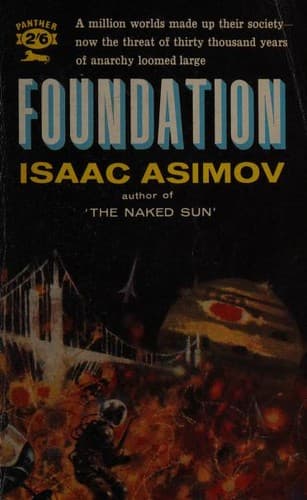
Foundation (1951)
About This Book
A mathematician named Hari Seldon develops a science called psychohistory that can predict the behavior of large populations over centuries, and when his calculations show that the Galactic Empire will collapse into thirty thousand years of barbarism, he creates a Foundation designed to shorten the dark age to a single millennium. Isaac Asimov built the grandest thought experiment in science fiction: a story that spans centuries and asks whether history can be engineered.
Why It's a Classic
Asimov's central conceit, that the behavior of billions of people could be predicted mathematically even though individual actions cannot, was inspired by the kinetic theory of gases and represents one of science fiction's most ambitious intellectual gambits. The novel's structure, covering several centuries through a series of connected crises, creates a sense of historical sweep that few novels achieve, and each crisis is resolved not through military force or heroism but through the economic and political forces that Seldon predicted. The Foundation stories challenged the genre's fixation on individual heroes by insisting that historical forces are bigger than any single person, a perspective that was radical in the pulp era and remains provocative. The concept of the Seldon Crisis, a moment when historical forces converge to create a situation with only one viable solution, is Asimov's most elegant narrative device: it generates suspense from inevitability. The novel inspired real scientists and technologists, and the concept of psychohistory has been seriously discussed as a forerunner of computational social science.
Fun Fact
Asimov began writing the Foundation stories as short fiction for Astounding Science Fiction magazine starting in 1942, when he was twenty-two years old, and did not assemble them into a novel until 1951. The concept of psychohistory was inspired by Edward Gibbon's 'The History of the Decline and Fall of the Roman Empire,' which Asimov read as a teenager and which provides the historical template for the Galactic Empire's collapse. Paul Krugman, the Nobel Prize-winning economist, has cited Foundation as the reason he became an economist: he wanted psychohistory to be real. Elon Musk has also cited the series as a formative influence. In 1966, the Foundation trilogy won a special Hugo Award for 'Best All-Time Series,' beating out The Lord of the Rings.
Parent Note
The novel contains political intrigue, manipulation, and implied violence, but very little graphic content. There are virtually no significant female characters, reflecting the biases of 1940s and 1950s science fiction. The prose is functional rather than literary, prioritizing ideas over style. The episodic structure (each section jumps forward decades or centuries) can be disorienting. No sexual content, strong language, or graphic violence. Suitable for readers fourteen and up. An excellent entry point into classic science fiction, though readers should be aware of its period limitations regarding representation.
Quick Facts
- Year
- 1951
- Type
- 📚 Book
- Category
- Fantasy / Sci-Fi
- Age Group
- Adults (Ages 18+)