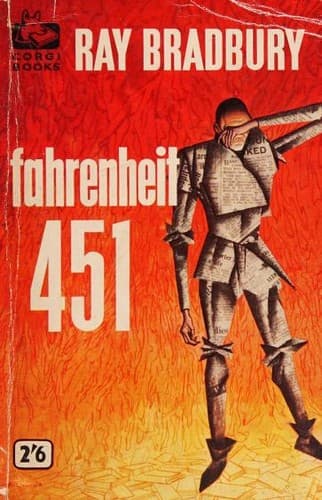
Fahrenheit 451 (1953)
About This Book
In a future America where books are banned and firemen burn any that are found, a fireman named Guy Montag begins to question his work after meeting a teenager who asks him whether he is happy, and his rebellion against a society addicted to screens, speed, and distraction takes him from conformist enforcer to fugitive intellectual. Ray Bradbury wrote a warning about censorship that has aged into a warning about something worse: voluntary ignorance.
Why It's a Classic
Bradbury's most prescient insight was that books would not be banned by a tyrannical government but abandoned by a population that preferred faster, easier, more passive forms of entertainment, and the novel's depiction of wall-sized interactive television screens, seashell earbuds, and a populace that cannot tolerate silence or complexity reads as almost documentary today. Montag's awakening is rendered with genuine emotional force: his first experience of reading, tentative and halting, is one of literature's most moving depictions of intellectual discovery. The Mechanical Hound, a robotic predator programmed to track and kill dissidents, is a brilliant symbol of technology repurposed for oppression. Captain Beatty, Montag's fire chief, is one of the great literary antagonists because he is not ignorant; he has read extensively and chosen to reject books, making him a far more formidable opponent than simple censorship. The novel's ending, in which fugitive intellectuals preserve books by memorizing them, is both hopeful and elegiac.
Fun Fact
Bradbury wrote the first draft in nine days on a rented typewriter in the UCLA library basement, paying ten cents for every thirty minutes of typing time, and the total cost of writing the novel was $9.80. He always insisted the novel was not about censorship but about the threat of television to reading, a distinction that critics and readers have debated ever since. The title refers to the temperature at which paper supposedly auto-ignites, though fire science experts have noted that the actual temperature varies significantly depending on the type of paper. Bradbury was famously afraid of flying and never learned to drive a car, which makes the novel's obsession with speed and technology all the more personal.
Parent Note
The novel contains scenes of book burning, a suicide attempt (Montag's wife overdoses on sleeping pills), violence including the death of a character by flamethrower, and a society's complete indifference to human connection. The atmosphere is oppressive but the violence is not graphic by modern standards. No sexual content. Mild language. The novel is short (roughly 160 pages) and accessible. Suitable for readers fourteen and up. One of the most frequently assigned novels in American schools and an essential text for discussions about censorship, media literacy, and the value of reading.
Quick Facts
- Year
- 1953
- Type
- 📚 Book
- Category
- Fantasy / Sci-Fi
- Age Group
- Adults (Ages 18+)