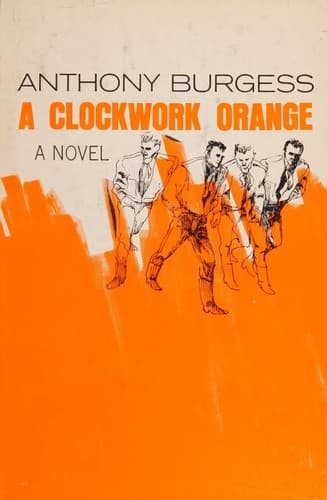
A Clockwork Orange (1962)
About This Book
Alex, a charismatic teenage delinquent who commits acts of horrifying violence for the pure joy of it, is captured by the state and subjected to a radical conditioning program that makes him physically ill at the thought of violence, and the novel asks whether a man who is forced to be good is truly good at all. Anthony Burgess wrote the ultimate thought experiment about free will, wrapping it in a language, Nadsat, that he invented from scratch.
Why It's a Classic
Burgess posed a question that has no comfortable answer: if a society can eliminate evil by eliminating the capacity for choice, should it? Alex is deliberately designed to make this question as hard as possible; he is not a sympathetic criminal but a genuinely vicious one who rapes, beats, and kills for pleasure, and yet the novel insists that removing his ability to choose evil also removes his humanity. The invented slang Nadsat, a fusion of Russian, English, and Cockney rhyming slang, forces the reader to learn Alex's language and thereby enter his worldview, a structural trick that makes the novel's moral argument experiential rather than abstract. The novel's twenty-first chapter, omitted from the American edition and from Kubrick's film, shows Alex maturing naturally out of violence, and Burgess considered this chapter essential: without it, the novel is a thesis about conditioning, but with it, the novel argues that genuine moral growth is possible only through freedom. The debate between the two versions continues.
Fun Fact
Burgess claimed to have written the novel in three weeks, partly motivated by financial necessity after being told (incorrectly, as it turned out) that he had a brain tumor and a year to live. Stanley Kubrick's 1971 film adaptation became notorious for its depiction of violence and was voluntarily withdrawn by Kubrick from British distribution after he received death threats, remaining unseen in the UK until after Kubrick's death in 1999. Burgess grew to resent the novel's fame, feeling that it overshadowed his other forty books, and he particularly disliked the American edition's omission of the final chapter, which he blamed on his American publisher's belief that Americans would not accept a redemptive ending.
Parent Note
The novel contains graphic depictions of violence including assault, rape (described but not with explicit detail), and murder, all narrated by the perpetrator in a tone of enthusiastic enjoyment. The Nadsat slang partially obscures the violence but does not eliminate it. The state conditioning sequences are disturbing. The philosophical questions raised are genuinely challenging. Language is the invented Nadsat, which takes a chapter or two to become readable. The novel is short (roughly 200 pages). The British edition with the twenty-first chapter is recommended. Suitable for readers seventeen and up. A controversial but essential text for discussions about free will, violence, and state power.
Quick Facts
- Year
- 1962
- Type
- 📚 Book
- Category
- Fantasy / Sci-Fi
- Age Group
- Adults (Ages 18+)