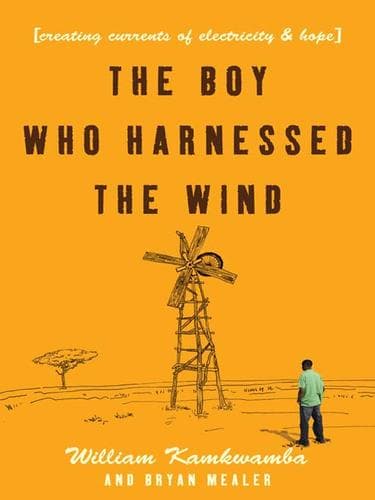
The Boy Who Harnessed the Wind (2009)
About This Book
When famine struck Malawi in 2001, fourteen year old William Kamkwamba was forced to drop out of school because his family could not afford the fees. Using a library book about energy, scrap bicycle parts, and materials scavenged from a junkyard, he built a functioning windmill that powered lights and eventually a water pump for his village. This is a story about ingenuity, persistence, and the stubborn refusal to accept that your circumstances define your limits.
Why It's a Classic
Kamkwamba's story resonates because it is so specifically detailed about the practical challenges of invention in a resource scarce environment, from the difficulty of finding PVC pipe in rural Malawi to the neighbors who called him crazy for climbing a tower made of scrap wood. The memoir, co written with journalist Bryan Mealer, captures the texture of daily life in a subsistence farming community with dignity and specificity rather than pity or sentimentality. Kamkwamba's persistence is extraordinary; he continued visiting the library and experimenting even after his family was surviving on one meal a day. The book also functions as an introduction to the physics of wind energy that is more engaging than any textbook. After a TED talk brought his story to international attention, Kamkwamba received scholarships, attended Dartmouth College, and returned to Malawi to continue working on renewable energy projects.
Fun Fact
Kamkwamba's first windmill was built from blue gum trees, bicycle parts, a tractor fan blade, and an old shock absorber. The library book that inspired him was called Using Energy, and he could barely read the English text; he relied heavily on the diagrams. His TED talk in 2007, delivered when he was just nineteen and still learning English fluently, received a standing ovation and went viral, leading directly to the book deal and subsequent film adaptation by Netflix.
Parent Note
The memoir describes famine conditions in honest detail, including hunger, malnutrition, and the death of neighbors. Kamkwamba's frustration at being unable to attend school and his family's desperation are emotionally intense. There is no violence, sexual content, or profanity. The science and engineering content makes it especially appealing for STEM oriented readers. It is appropriate for ages 10 and up.
Quick Facts
- Year
- 2009
- Type
- 📚 Book
- Category
- Non-Fiction / Biography
- Age Group
- Teens (Ages 14–17)