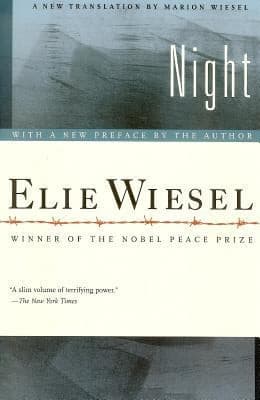
Night (1960)
About This Book
Elie Wiesel was fifteen when he and his father were deported from their village in Romania to Auschwitz, and Night is his account of what they endured across two concentration camps during the final year of World War II. Written in sparse, haunted prose, the memoir documents the systematic destruction of everything Wiesel believed about God, humanity, and his own capacity to remain good. It is one of the shortest and most devastating books you will ever read.
Why It's a Classic
Wiesel originally wrote a much longer Yiddish manuscript titled 'And the World Remained Silent,' which he compressed into the brief, controlled French text that became Night, and that compression gives every sentence the weight of testimony under oath. The memoir charts not just physical survival but the disintegration of Wiesel's faith, moving from a boy who studied the Talmud and wept during prayer to a man who watched hangings and felt nothing. The relationship between Elie and his father Shlomo anchors the narrative, and its slow erosion under the pressures of starvation and exhaustion is almost unbearable to read. Wiesel went on to win the Nobel Peace Prize in 1986, dedicating his life to ensuring the Holocaust would not be forgotten or denied. Night has sold over ten million copies and is considered essential reading for understanding the 20th century.
Fun Fact
Wiesel's original 900 page Yiddish manuscript was edited down to 127 pages with the help of the French Nobel laureate Francois Mauriac, who also wrote the foreword. Wiesel waited ten years after his liberation before writing about his experiences, feeling that silence was the only appropriate response before eventually concluding that silence would serve the perpetrators. He taught at Boston University for decades and used his Nobel Prize platform to speak on behalf of oppressed peoples worldwide.
Parent Note
Night describes starvation, beatings, death marches, executions, and the murder of children, all witnessed firsthand by a teenager. The descriptions are restrained but the events themselves are extreme, and the cumulative effect is emotionally devastating. A scene in which inmates fight over bread thrown into their train car and a son kills his father for food is particularly harrowing. There is no sexual content. It is typically assigned around ages 13 to 15, and adults should be prepared to support teens through the emotional weight of this reading.
Quick Facts
- Year
- 1960
- Type
- 📚 Book
- Category
- Non-Fiction / Biography
- Age Group
- Teens (Ages 14–17)