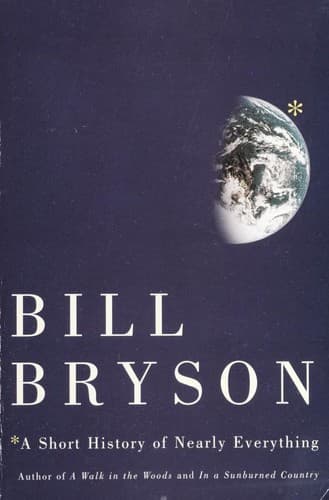
A Short History of Nearly Everything (2003)
About This Book
Bill Bryson set out to understand how we know what we know about the universe, from the Big Bang to the rise of civilization, and the result is the most entertaining science book ever written. He interviews scientists, visits laboratories, and explains everything from plate tectonics to quantum mechanics with humor, wonder, and a gift for making the incomprehensibly large and small feel personal. You will finish this book knowing more about how the world works and feeling astonished that it works at all.
Why It's a Classic
Bryson's great achievement is making complex science not just accessible but genuinely thrilling, treating the history of scientific discovery as an adventure story full of eccentric geniuses, bitter rivalries, and astonishing coincidences. He explains the scale of atoms by calculating that a single glass of water contains enough molecules to fill a medium sized lake, and he conveys geological time by compressing Earth's history so that a human lifetime equals half a second. The book also does not shy away from the many times science got things spectacularly wrong, which paradoxically makes the eventual discoveries more impressive. Bryson's humor is essential to his method; by making readers laugh, he keeps them engaged through material that might otherwise feel like a textbook. The book has sold over three million copies and has been credited by countless readers as the book that made them fall in love with science.
Fun Fact
Bryson has said he was inspired to write the book by a childhood moment of staring at a cross section diagram of the Earth in a textbook and wondering how anyone actually knew what was down there. He spent three years researching, reading over a thousand books and scientific papers and interviewing dozens of experts. The illustrated edition, published in 2005, added photographs and diagrams that made the science even more accessible, and a 'Short History' edition was later adapted specifically for younger readers.
Parent Note
The book discusses natural disasters, mass extinctions, and the eventual death of the sun in a factual, often humorous tone. There are descriptions of diseases and the physical effects of extreme environments on the human body. There is no violence, sexual content, or profanity. The reading level is aimed at adults but is accessible to strong teen readers, and the humor and narrative style make challenging scientific concepts manageable. It is appropriate for ages 12 and up.
Quick Facts
- Year
- 2003
- Type
- 📚 Book
- Category
- Non-Fiction / Biography
- Age Group
- Teens (Ages 14–17)