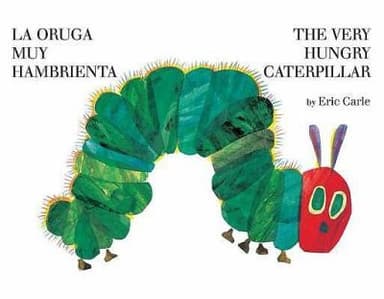
The Very Hungry Caterpillar (1969)
About This Book
A tiny caterpillar eats his way through apples, plums, strawberries, chocolate cake, ice cream, and an increasingly absurd pile of food before spinning a cocoon and emerging as a spectacular butterfly. The pages themselves have holes punched through them where the caterpillar has eaten, turning reading into a tactile experience. It teaches counting, days of the week, and the wonder of metamorphosis without ever feeling like a lesson.
Why It's a Classic
Eric Carle invented a new kind of picture book with this title, one where the physical object itself is part of the storytelling. The die-cut holes let toddlers poke their fingers through the pages, transforming a passive reading experience into an interactive one. Carle's tissue paper collage technique produces colors that feel saturated and alive, almost edible, which is exactly right for a book about consuming the world. The narrative structure is sneakily sophisticated: it moves through a predictable counting pattern, breaks that pattern with the Saturday binge, introduces a consequence (the stomachache), and resolves with transformation. That arc mirrors a child's own experience of excess and recovery in miniature. The final butterfly spread, with its enormous wings filling both pages, delivers a genuine moment of awe that never diminishes no matter how many times you read it.
Fun Fact
Carle's original concept was "A Week with Willi the Worm," featuring a bookworm eating through the pages, but his editor Ann Beneduce suggested changing the character to a caterpillar so the story could end with a transformation. The book has been translated into more than 70 languages and has sold over 55 million copies worldwide. Carle created his distinctive illustrations by hand painting tissue paper, cutting it into shapes, and layering the pieces into collages.
Parent Note
This book is nearly indestructible in board book form, which is fortunate because babies and toddlers will chew on it, bend it, and poke every hole relentlessly. There is nothing remotely scary or sad in the entire book. It works beautifully from about six months old (for the colors and textures) through age five (for the counting and days of the week).
Quick Facts
- Year
- 1969
- Type
- 📚 Book
- Category
- Fantasy
- Age Group
- Little Kids (Ages 3–6)