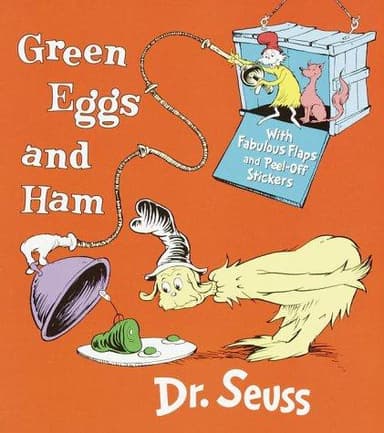
Green Eggs and Ham (1960)
About This Book
The relentless Sam-I-Am pursues a grumpy unnamed character across increasingly ridiculous locations, from boats to trains to treetops, trying to convince him to taste green eggs and ham. The rhymes are so perfectly constructed that toddlers memorize entire passages after just a few readings. It is a story about trying new things, told with manic energy and zero subtlety, exactly the way kids like it.
Why It's a Classic
Dr. Seuss wrote this book on a bet with his publisher Bennett Cerf, who wagered that Seuss could not write an entertaining book using only fifty different words. Seuss won the bet and created one of the bestselling children's books in history. The constraint forced an incredible economy of language: Seuss builds escalating comedy through nothing but rearrangement and repetition, the way a jazz musician works variations on a simple theme. Sam-I-Am's persistence is funny because it is so unreasonable, and the final capitulation, when the grumpy character actually enjoys the green eggs and ham, delivers real satisfaction. The book also works as a child's first encounter with persuasive rhetoric; Sam-I-Am never gives up, never changes his pitch, and eventually wears down all resistance through sheer cheerful persistence. Seuss understood that children find repetition comforting and escalation thrilling, and this book delivers both in perfect measure.
Fun Fact
Bennett Cerf, the co-founder of Random House, bet Seuss fifty dollars that he could not write a book using only fifty unique words. Seuss accomplished it, but Cerf allegedly never paid up. The book has sold more than 200 million copies, making it one of the bestselling books of all time in any genre. In 2016, a copy of an early edition was reportedly found tucked inside a wall during a home renovation.
Parent Note
There is nothing here that could possibly upset anyone. The book is pure silliness from start to finish. It works as an early reader because the limited vocabulary and strong rhyme scheme give beginning readers real confidence. Children as young as eighteen months enjoy the rhythm, and kids up to six or seven can read it independently as one of their first chapter conquests.
Quick Facts
- Year
- 1960
- Type
- 📚 Book
- Category
- Humor
- Age Group
- Little Kids (Ages 3–6)