Harold and the Purple Crayon (1955)
About This Book
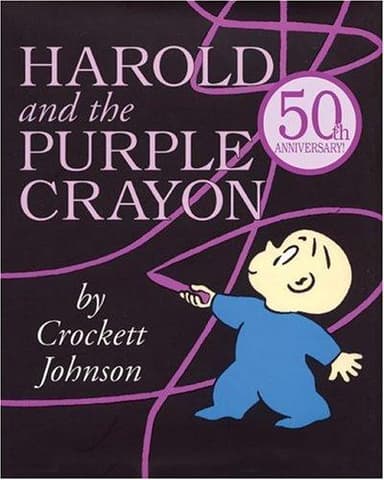
A small boy in pajamas picks up an oversized purple crayon and draws himself an entire world: a path to walk on, a moon to light his way, a mountain to climb, and an ocean to sail across. Every problem Harold encounters he solves by drawing the next thing he needs. The simplicity of the white page filling with purple lines makes every child feel that the same power lives in their own hands.
Why It's a Classic
Crockett Johnson stripped picture book illustration down to its most essential elements: a blank page, a single color, and a child's line. The genius of the concept is that Harold is simultaneously the protagonist, the author, and the illustrator of his own story, which makes the book a meditation on creativity itself. When Harold draws nine kinds of pie and then draws a moose and a porcupine to eat them, Johnson captures the free associative logic of childhood play perfectly. The book also contains a genuinely philosophical tension: Harold controls his world completely, yet he keeps drawing himself into trouble, suggesting that imagination carries real consequences even in fantasy. Johnson's spare, wobbly line has the look of a child's own drawing, which is precisely the point. The final scene, where Harold draws his bedroom window and tucks himself into his drawn bed, closes the loop with a quiet elegance that picture books rarely achieve.
Fun Fact
Crockett Johnson was actually a pen name; his real name was David Johnson Leisk. Before creating Harold, he was best known for his comic strip "Barnaby," which ran in newspapers throughout the 1940s and was admired by Dorothy Parker and other literary figures. Later in life, Johnson became obsessed with geometric painting and created over 100 canvases based on mathematical theorems, many of which now hang in the Smithsonian.
Parent Note
There is absolutely nothing scary or inappropriate in this book. The spare illustrations and quiet tone make it an excellent bedtime read. Children as young as two enjoy following Harold's purple line across the pages, while four and five year olds start to grasp the deeper idea that you can create your own world through drawing and imagination.
Quick Facts
- Year
- 1955
- Type
- 📚 Book
- Category
- Fantasy
- Age Group
- Little Kids (Ages 3–6)