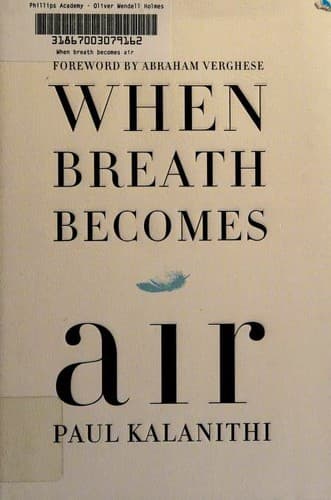
When Breath Becomes Air (2016)
About This Book
A neurosurgeon on the verge of completing his residency is diagnosed with stage IV lung cancer at age thirty-six, and in the months that remain, he writes a memoir that moves between his early fascination with literature and meaning, his decision to pursue medicine, his experience of being a doctor who becomes a patient, and his confrontation with the question that drove both his vocations: what makes a life worth living? Paul Kalanithi wrote one of the most moving books about mortality ever published.
Why It's a Classic
Kalanithi brought two rare qualifications to writing about dying: a literary education (he studied English literature at Stanford and Cambridge before medical school) that gave him the language to articulate experiences that most people find inexpressible, and a neurosurgeon's intimate knowledge of the brain and body that prevented him from retreating into platitudes. His description of the moment when the CT scan reveals his cancer, and he shifts from being the doctor reading the scan to the patient whose scan it is, is one of the most precisely rendered transitions in memoir. The book does not offer comfort or wisdom about death; instead, it documents a man thinking clearly and beautifully under the most extreme pressure, making decisions about what to do with his remaining time (continue operating, start a family, write) that are neither heroic nor despairing but simply, achingly human. The epilogue, written by his wife Lucy after his death, provides the emotional completion that the memoir itself, by definition, could not.
Fun Fact
Kalanithi died on March 9, 2015, at age thirty-seven, before the book was published. His wife, Lucy Kalanithi, oversaw the manuscript's completion and publication. The book spent over sixty weeks on the New York Times bestseller list. Kalanithi and his wife decided to have a child after his diagnosis, and their daughter, Elizabeth Acadia (Cady), was born in 2014. He wrote much of the book during breaks between chemotherapy treatments. Abraham Verghese, the physician-writer who wrote the foreword, had been Kalanithi's mentor at Stanford. The title comes from a poem by Baron Brooke Fulke Greville.
Parent Note
The book describes terminal illness, chemotherapy, physical deterioration, and death. The medical details are rendered with a clinician's precision but the emotional weight is carried by the human story. The knowledge that the author died before the book's publication adds an unavoidable sadness to every page. There is no graphic violence, sexual content, or strong language. The book is short (roughly 230 pages) and beautifully written. May be particularly difficult for readers who have lost someone to cancer or who are dealing with terminal illness. Suitable for readers fifteen and up. One of the most important books about mortality published in the twenty-first century.
Quick Facts
- Year
- 2016
- Type
- 📚 Book
- Category
- Non-Fiction / Memoir
- Age Group
- Adults (Ages 18+)