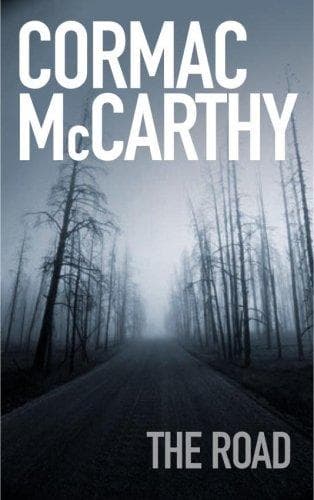
The Road (2006)
About This Book
A father and his young son walk through the ashen ruins of a post-apocalyptic America, pushing a shopping cart containing everything they own, heading south toward the coast in the hope of finding warmth and safety. Cormac McCarthy stripped his prose to its barest elements to tell the most primal story imaginable: a parent trying to keep a child alive in a world that has ended.
Why It's a Classic
McCarthy achieved something remarkable: a novel about the end of the world that is ultimately about love. The father's devotion to his son, his willingness to do anything to protect the boy while also trying to preserve the boy's moral compass ('carrying the fire,' as they call it), gives the novel an emotional force that cuts through its apocalyptic setting. The prose is McCarthy's most pared down, short declarative sentences and sentence fragments that mirror the stripped world they describe, and the absence of quotation marks and apostrophes creates a visual flatness on the page that reinforces the landscape. The unnamed catastrophe that destroyed civilization is never explained, because McCarthy understood that the cause matters less than the question: how do you remain human when humanity has collapsed? The ending, which provides a sliver of hope without betraying the novel's honesty about suffering, is one of the most debated and discussed in contemporary fiction. The Pulitzer Prize committee recognized it as a masterwork immediately upon publication.
Fun Fact
McCarthy has said that the novel was inspired by a trip to El Paso, Texas, with his young son, during which he imagined what the city might look like in fifty or a hundred years and began thinking about paternal love and the end of the world. He was in his seventies when he wrote it, and the novel's emotional intensity is often attributed to his experience of late fatherhood. Oprah Winfrey selected it for her book club in 2007, making it one of the few works of serious literary fiction to reach a mass audience through that channel. McCarthy famously does not use semicolons, calling them unnecessary, and The Road extends this minimalism to apostrophes and quotation marks as well.
Parent Note
The novel depicts a post-apocalyptic world with extreme violence, including cannibalism (encountered multiple times), murder, suicide, starvation, and the constant threat of death. There is a brief, disturbing scene involving a basement that many readers find deeply upsetting. The emotional weight of a parent protecting a child in a hopeless world is heavy and may be particularly affecting for parents. No sexual content. The prose is accessible despite its literary qualities. Best for readers sixteen and up. The novel is devastating but ultimately affirming, though the journey to that affirmation is harrowing.
Quick Facts
- Year
- 2006
- Type
- 📚 Book
- Category
- Adventure
- Age Group
- Adults (Ages 18+)