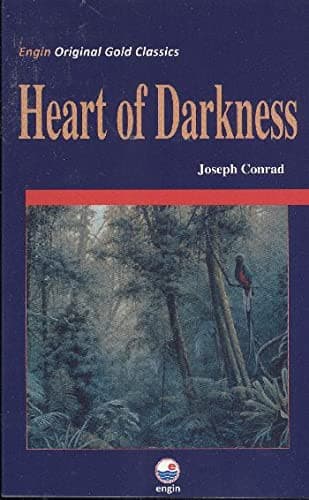
Heart of Darkness (1899)
About This Book
A steamboat captain travels up the Congo River into the interior of Africa to retrieve a brilliant ivory trader named Kurtz who has abandoned civilization and established himself as a god among the local people, and what he finds there forces a confrontation with the violence at the core of European colonialism. Joseph Conrad wrote a novella so dense with meaning that it has generated more critical debate than novels ten times its length.
Why It's a Classic
Conrad's prose style, layered and hallucinatory, mirrors the journey itself: the further Marlow travels upriver, the more the language dissolves into ambiguity, as if the certainties of European civilization are literally evaporating in the heat. Kurtz's final words, 'The horror! The horror!', have become one of literature's most quoted and debated phrases, capable of referring to colonialism, to human nature, to Kurtz's own actions, or to the impossibility of articulating what he has seen. The novella is remarkable for being simultaneously a critique of imperialism (Conrad saw Belgian rule in the Congo firsthand and was appalled) and a product of its era's racial assumptions, a tension that Chinua Achebe famously addressed in his 1977 essay calling the book racist. This duality makes it one of the most productive texts for classroom discussion in the Western canon. Francis Ford Coppola's Apocalypse Now transposed the story to Vietnam, demonstrating the narrative's adaptability to any context where civilized people discover their own capacity for savagery.
Fun Fact
Conrad based the story on his own experience commanding a steamboat on the Congo River in 1890, a journey that left him physically ill and psychologically scarred. He witnessed atrocities committed by Belgian colonizers, including forced labor, mutilation, and mass death, that informed the novella's depiction of imperial brutality. The story is only about 38,000 words, roughly one hundred pages, yet it appears on virtually every list of the greatest works in the English language. Conrad's first language was Polish, and English was his third language after Polish and French, making his mastery of English prose all the more remarkable.
Parent Note
The novella depicts colonial violence, enslavement, death, and psychological breakdown. Conrad's portrayal of African people has been criticized as dehumanizing, reducing them to backdrop for a European psychological drama, and this criticism (most notably Achebe's) should be part of any reading. The prose is dense and requires close attention. The racial language reflects the colonial era. Best for readers seventeen and up, ideally read alongside Achebe's critique or Achebe's own novel Things Fall Apart. The Norton Critical Edition is recommended for its inclusion of critical essays.
Quick Facts
- Year
- 1899
- Type
- 📚 Book
- Category
- Adventure
- Age Group
- Adults (Ages 18+)