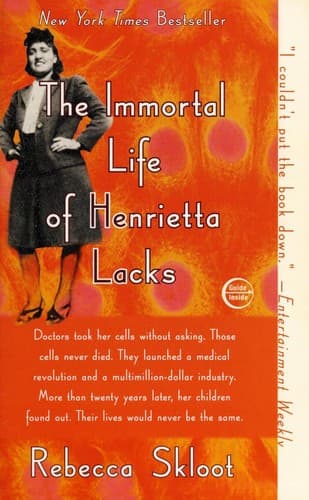
The Immortal Life of Henrietta Lacks (2010)
About This Book
In 1951, a poor Black tobacco farmer named Henrietta Lacks was treated for cervical cancer at Johns Hopkins Hospital, and her cancer cells, taken without her knowledge or consent, became the first human cells to survive and multiply indefinitely in a laboratory. Known as HeLa cells, they became one of the most important tools in medical research, contributing to the polio vaccine, gene mapping, and countless other breakthroughs, while Lacks' family remained unaware and uncompensated. Rebecca Skloot spent a decade researching and writing the book that told Henrietta's story.
Why It's a Classic
Skloot wove together three narratives: the scientific history of HeLa cells and their contribution to modern medicine, the biographical story of Henrietta Lacks and her family, and the ethical questions raised by the use of human tissue without consent, and the intersection of these three threads creates a book that is simultaneously a science story, a family portrait, and a moral argument. The Lacks family's experience, discovering decades later that their mother's cells were being bought and sold by laboratories while they could not afford health insurance, is a microcosm of racial inequality in American medicine. Skloot's relationship with Deborah Lacks, Henrietta's daughter, provides the book's emotional center: Deborah's desperate need to understand what happened to her mother and what the cells meant gives the scientific narrative a human urgency that transforms it from journalism into literature. The book raised questions about informed consent, the ownership of biological materials, and the racial dimensions of medical research that led to policy changes at the National Institutes of Health.
Fun Fact
Skloot spent ten years researching the book, beginning as an undergraduate who encountered HeLa cells in a biology class and became obsessed with learning who the woman behind them was. Building trust with the Lacks family took years, as they had been exploited by previous journalists and researchers. HeLa cells have been used in over 75,000 scientific studies, and they contributed to two Nobel Prizes. The cells are so prolific that they have contaminated other cell cultures in laboratories worldwide, complicating scientific research. In 2013, the NIH reached an agreement with the Lacks family granting them some control over access to HeLa cell genomic data. An HBO film adaptation starring Oprah Winfrey premiered in 2017.
Parent Note
The book describes the details of Henrietta Lacks' illness and death from cervical cancer, medical procedures performed without consent, the historical context of racially segregated medicine, poverty, family dysfunction, and the psychological impact of learning that a loved one's cells have been commercialized. The descriptions of medical procedures are clinical rather than graphic. There is discussion of sexually transmitted disease (HPV). No strong language. The book is roughly 370 pages and is written for a general audience. Suitable for readers fifteen and up. Essential reading for understanding medical ethics, racial inequality in healthcare, and the human stories behind scientific progress.
Quick Facts
- Year
- 2010
- Type
- 📚 Book
- Category
- Non-Fiction / Memoir
- Age Group
- Adults (Ages 18+)