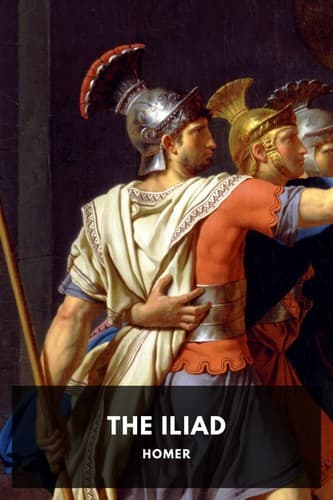
The Iliad (-750)
About This Book
In the tenth year of the Trojan War, the greatest Greek warrior Achilles withdraws from battle after being publicly dishonored by his commander, and the consequences of his rage reshape the course of the war, the lives of gods and mortals, and the meaning of glory, mortality, and compassion. Homer's war epic is the oldest work of Western literature and still one of its fiercest and most moving.
Why It's a Classic
Homer's achievement is presenting war in all its dimensions simultaneously: the glory of individual combat, the waste of young lives, the grief of families, and the arbitrary cruelty of gods who treat human suffering as entertainment. Achilles is not a simple hero; he is a man who knows he will die young and must decide whether a short, glorious life is worth the price, and his journey from rage to grief to a devastating moment of compassion with his enemy's father (Priam, begging for Hector's body) constitutes one of the great emotional arcs in all of literature. The battle scenes are shockingly visceral for a poem composed nearly three thousand years ago: Homer describes wounds with the clinical precision of a field surgeon, and the effect is to strip away any romantic abstraction from the violence. The similes, comparing warriors to lions, storms, and forest fires, create a bridge between the human world and the natural world that makes the poem feel cosmic in scope. The poem's final image, the funeral of Hector, is not a Greek triumph but a moment of shared grief that transcends the division between enemies.
Fun Fact
The Iliad covers only about two weeks in the tenth year of the Trojan War, yet its 15,693 lines create the impression of encompassing the entire conflict. The poem was composed orally and transmitted by memory for centuries before being written down, probably in the eighth century BCE. Heinrich Schliemann, a nineteenth century amateur archaeologist who believed Homer's Troy was a real place, excavated a site at Hissarlik in modern Turkey that is now generally accepted as the historical Troy. Caroline Alexander's 2015 translation was the first by a woman and emphasized the poem's antiwar dimensions. The word 'Achilles' heel,' meaning a fatal weakness, derives from a later tradition (not in Homer) that Achilles' mother dipped him in the River Styx, making him invulnerable everywhere except the heel she held him by.
Parent Note
The poem contains extensive battlefield violence described in graphic anatomical detail: spear wounds, decapitations, and dying speeches are frequent. Characters are killed in ways that emphasize the physical reality of death. The poem also depicts the enslavement and forced concubinage of women captured in war, a practice presented as normal in its ancient context. The gods behave capriciously and sometimes cruelly. Translation choice significantly affects accessibility. Caroline Alexander's (2015) or Robert Fagles' (1990) translations are recommended for modern readers. Suitable for older teens and up. Reading alongside The Odyssey provides the full Homeric experience.
Quick Facts
- Year
- -750
- Type
- 📚 Book
- Category
- Adventure
- Age Group
- Adults (Ages 18+)