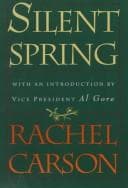
Silent Spring (1962)
About This Book
A marine biologist documents the devastating effects of synthetic pesticides, particularly DDT, on the natural environment, showing how these chemicals move through ecosystems, accumulating in the tissues of animals and humans, killing wildlife, and poisoning the landscapes they were supposed to protect. Rachel Carson wrote the book that launched the modern environmental movement and led directly to the creation of the Environmental Protection Agency.
Why It's a Classic
Carson's achievement was making the invisible visible: the chemicals she described were odorless, tasteless, and marketed as safe, and their effects (thinning eggshells in birds, cancer in humans, the death of entire insect populations) operated on timescales and through mechanisms that were invisible to casual observation. Her prose combined scientific precision with literary beauty, and chapters like 'A Fable for Tomorrow,' which describes a town where spring arrives in silence because the birds have all been killed by pesticides, are as powerful as any fiction. The chemical industry mounted a massive campaign to discredit Carson personally, calling her hysterical, unscientific, and a communist, and the gendered nature of these attacks has been widely analyzed by historians. President Kennedy ordered a Science Advisory Committee investigation of the claims in Silent Spring, and the committee's report vindicated Carson on virtually every point. The book led to the ban on DDT in the United States and to the creation of the EPA in 1970.
Fun Fact
Carson was diagnosed with breast cancer while writing the book and completed it knowing she might not live to see its impact. She died in April 1964, less than two years after publication, at age fifty-six. The chemical industry spent an estimated $250,000 (equivalent to roughly $2.5 million today) on a campaign to discredit the book. One industry executive suggested that because Carson was unmarried, she was 'probably a Communist.' Carson's earlier books, 'The Sea Around Us' and 'The Edge of the Sea,' were bestsellers that established her reputation as one of the finest science writers in English. She never called for a total ban on pesticides, only for more careful and scientifically informed use, a nuance that her critics often ignored.
Parent Note
The book describes the effects of chemical poisoning on wildlife and humans, including cancer, birth defects, and the death of entire animal populations. The descriptions are scientific rather than graphic, but the cumulative effect of learning how deeply these chemicals penetrate ecosystems can be distressing. No violence, sexual content, or strong language. The science has been largely validated but some specific claims have been updated by subsequent research. The book is roughly 300 pages and is accessibly written. Suitable for readers fourteen and up. Essential reading for understanding the environmental movement and the relationship between science, industry, and public policy.
Quick Facts
- Year
- 1962
- Type
- 📚 Book
- Category
- Non-Fiction / Memoir
- Age Group
- Adults (Ages 18+)