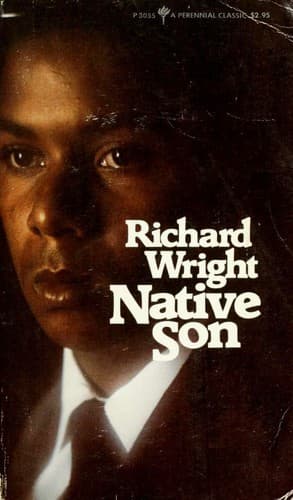
Native Son (1940)
About This Book
Bigger Thomas, a young Black man living in poverty on Chicago's South Side, takes a job as a chauffeur for a wealthy white family, and a series of panicked decisions leads to a crime that reveals the suffocating reality of American racism with a force that no previous novel had attempted. Richard Wright wrote a protest novel so violent and uncompromising that it forced white America to look at what it had created.
Why It's a Classic
Wright refused to make Bigger sympathetic in the conventional sense: he is not noble, not articulate, not a victim who suffers gracefully, but a man whose rage, fear, and violence are the products of a system that denied him every avenue of legitimate self-expression. The novel's power comes from Wright's insistence that Bigger's crimes are not excused by racism but are made comprehensible by it, and the reader is forced to hold two truths simultaneously: that what Bigger does is terrible, and that America created the conditions that made him. The courtroom speech by Boris Max, Bigger's communist lawyer, which attempts to explain Bigger's actions as the inevitable consequence of systemic oppression, is one of the great set pieces of political fiction, and the debate about whether Max succeeds or fails mirrors the larger American debate about personal responsibility and structural injustice. The novel scandalized both white and Black audiences: whites objected to its depiction of Black rage, while some Black writers, including James Baldwin, argued that Wright reduced his protagonist to a social thesis rather than a complete human being. This debate remains vital.
Fun Fact
Wright wrote the novel while living in a rented room in Brooklyn, and the manuscript went through multiple revisions after his editor at Harper and Brothers insisted he tone down the sexual content and violence, changes Wright resented. The Book-of-the-Month Club selected it as a main selection in 1940, making Wright the first Black author to achieve that distinction. The novel sold 200,000 copies in its first three weeks. Wright based some elements of Bigger's story on the real case of Robert Nixon, a Black teenager executed for murder in Chicago in 1939. James Baldwin's essay 'Everybody's Protest Novel' (1949) critiqued Native Son's approach, arguing that it reduced Black experience to sociology, a critique that complicated but did not diminish the novel's impact.
Parent Note
The novel contains murder (two killings, one accidental and one deliberate), the mutilation and burning of a body, sexual violence (an attempted rape and an actual rape in some editions), extreme racial hatred, and the relentless pressure of poverty and racism on the protagonist's psyche. The violence is graphic and disturbing. The racial language reflects the era and is used by both white and Black characters. Bigger is not an easy character to spend time with, which is Wright's point. The novel is roughly 400 pages and reads quickly despite its weight. Suitable for readers seventeen and up. A landmark of American literature that remains powerful and controversial.
Quick Facts
- Year
- 1940
- Type
- 📚 Book
- Category
- Classic Novels
- Age Group
- Adults (Ages 18+)