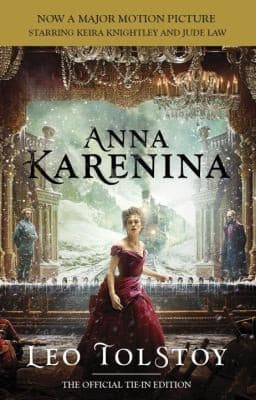
Anna Karenina (1877)
About This Book
A married Russian aristocrat begins an affair with a dashing cavalry officer, and the passion that initially liberates her gradually destroys her as society closes ranks against a woman who refuses to hide her transgression. Meanwhile, a landowner named Levin searches for meaning through farming, philosophy, and a love that is everything Anna's is not: stable, domestic, and quietly transcendent. Tolstoy wrote the greatest novel about love, marriage, and society, and its first sentence, 'All happy families are alike; each unhappy family is unhappy in its own way,' remains the most famous opening line in fiction.
Why It's a Classic
Tolstoy's genius was refusing to reduce Anna's story to a morality tale: she is not simply a fallen woman or a victim of society, but a fully realized human being whose passion for Vronsky is simultaneously her greatest vitality and her destruction. The novel follows Anna's increasing isolation and paranoia with clinical precision, showing how jealousy, social ostracism, and morphine addiction combine to narrow her world until the only exit she can imagine is the one she takes. Levin's parallel story, based closely on Tolstoy's own life, provides a counterpoint that is less dramatic but equally profound: his struggles with the meaning of work, his relationship to the peasants on his estate, and his eventual discovery of faith are rendered with a honesty that makes the reader feel they are witnessing someone think through the deepest questions in real time. The scene at the horse race, where Anna's reaction to Vronsky's fall publicly exposes their affair to her husband, is one of the most masterfully constructed set pieces in fiction. Dostoevsky called it 'flawless as a work of art.'
Fun Fact
Tolstoy was inspired by a real incident: a woman named Anna Pirogova threw herself under a train at a railway station near his estate after being abandoned by her lover. Tolstoy went to see the body at the station and the image haunted him. He initially conceived Anna as an unsympathetic character but found her becoming more complex and sympathetic as he wrote. The novel was serialized in The Russian Messenger from 1873 to 1877, and the serialization was interrupted by a dispute with the editor over Tolstoy's philosophical passages. Nabokov called the novel 'one of the greatest love stories in world literature.' The epigraph, 'Vengeance is mine; I will repay,' from Romans 12:19, sets up the central question of who is judging Anna: society, God, or herself.
Parent Note
The novel contains adultery as its central subject, a suicide that is described with devastating emotional impact, morphine addiction, themes of social hypocrisy, and discussions of faith and philosophy. There is no explicit sexual content; the affair is handled with nineteenth century discretion. The novel's length (roughly 800 pages) and the dual plot structure require commitment. The Pevear and Volokhonsky translation is widely praised, as is the Rosamund Bartlett translation. Suitable for readers sixteen and up. One of the supreme achievements of world literature.
Quick Facts
- Year
- 1877
- Type
- 📚 Book
- Category
- Classic Novels
- Age Group
- Adults (Ages 18+)