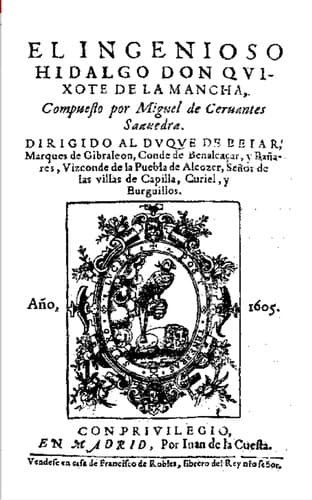
Don Quixote (1605)
About This Book
An aging Spanish gentleman reads so many chivalric romances that he loses his grip on reality, dubs himself a knight errant, recruits a bewildered farmer named Sancho Panza as his squire, and rides out to right wrongs and fight giants that turn out to be windmills. Miguel de Cervantes wrote the first modern novel, and its four-hundred-year-old comedy about the collision between imagination and reality has never stopped being funny, sad, and true.
Why It's a Classic
Cervantes invented the novel as we know it by doing something no writer before him had attempted: he placed an idealist inside a realistic world and let the friction between the two generate comedy, tragedy, and philosophical insight simultaneously. Don Quixote's madness is not simple delusion; it is a commitment to living as if the world were better than it is, and as the novel progresses, Cervantes shifts the reader's sympathies until the knight's foolishness becomes indistinguishable from nobility. Sancho Panza, who begins as a comic foil motivated by the promise of an island to govern, develops into one of literature's most beloved characters, his practical wisdom providing a counterpoint to his master's idealism that neither character could function without. The novel's second part, published in 1615, is even more remarkable than the first, because Cervantes makes Don Quixote and Sancho aware that the first part has been published, turning them into characters who know they are characters. This metafictional device was three centuries ahead of its time.
Fun Fact
Cervantes wrote the novel partly while in prison, where he was serving time for financial irregularities in his work as a tax collector. A fraudulent second part of Don Quixote was published in 1614 by an unknown author using the pseudonym Avellaneda, which prompted Cervantes to write the genuine Part Two and include passages mocking the impostor. The phrase 'tilting at windmills' entered dozens of languages as an expression for fighting imaginary enemies. Cervantes and Shakespeare died on the same date, April 23, 1616, though not actually on the same day because Spain and England used different calendars at the time.
Parent Note
The novel contains comedic violence (beatings, falls, and mishaps that are played for humor in a slapstick tradition), mild romantic content, and period-appropriate attitudes toward women, religion, and social class. Some episodes involve deception and cruelty toward Don Quixote that modern readers may find uncomfortable. The novel's length (roughly 1,000 pages for both parts) is substantial, and the episodic structure means it can be read in stretches. Translation choice matters enormously: Edith Grossman's 2003 translation is widely praised for its readability. Suitable for older teens and up, though the humor and philosophical depth are best appreciated by adult readers.
Quick Facts
- Year
- 1605
- Type
- 📚 Book
- Category
- Adventure
- Age Group
- Adults (Ages 18+)