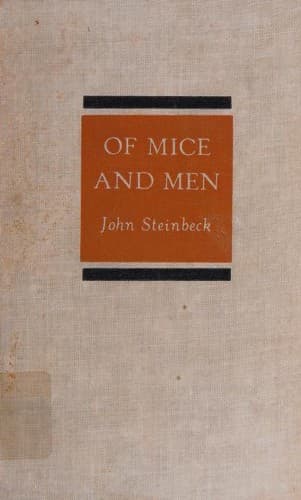
Of Mice and Men (1937)
About This Book
George and Lennie are migrant workers in Depression era California, drifting from ranch to ranch with a shared dream of saving enough money to buy their own small farm. George is sharp and protective; Lennie is enormous, gentle, and intellectually disabled, with a dangerous inability to control his own strength. Steinbeck tells their story in barely a hundred pages, and the ending is one of the most emotionally shattering in American literature.
Why It's a Classic
Steinbeck wrote this novel in a form he called a 'play novelette,' designing it so it could be performed on stage with almost no adaptation, and the tight structure gives the story a compressed power that a longer novel could not achieve. Every detail, from the dead mouse in Lennie's pocket to Candy's old dog, foreshadows the conclusion with a precision that becomes devastating on rereading. The novel is a study of loneliness and the way powerless people cling to dreams they know will never come true, and Steinbeck treats his characters with a compassion that never becomes sentimentality. The relationship between George and Lennie is one of literature's great portraits of friendship and caretaking, complicated by the fact that George's protectiveness cannot ultimately protect Lennie from himself. Steinbeck won the Nobel Prize in Literature in 1962, and this novella remains his most widely read and most frequently performed work.
Fun Fact
Steinbeck's puppy ate the original manuscript, and he had to rewrite the entire novel from memory. He originally titled it 'Something That Happened' before taking the final title from Robert Burns's poem 'To a Mouse,' which contains the line 'The best laid schemes o' mice an' men / Gang aft agley.' The novel was banned repeatedly for profanity and racial language, and it remains one of the most challenged books in American libraries.
Parent Note
The novel contains racial slurs used in period accurate dialogue, descriptions of violence including a mercy killing that is the climactic event, and the shooting of an old dog that parallels the ending. There are references to a segregated Black worker and a scene in which a woman's death occurs accidentally. The language is accessible but the emotional content is heavy, and the ending in particular may be deeply upsetting for sensitive readers. It is typically assigned around ages 13 to 15.
Quick Facts
- Year
- 1937
- Type
- 📚 Book
- Category
- Classics / Literature
- Age Group
- Teens (Ages 14–17)