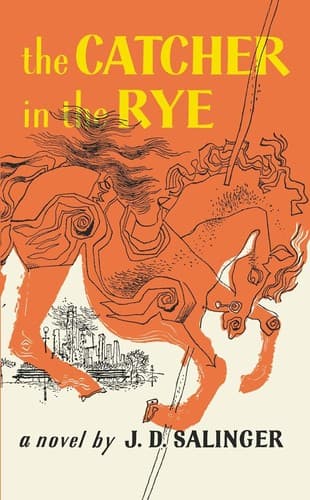
The Catcher in the Rye (1951)
About This Book
Holden Caulfield has just been expelled from his fourth prep school, and instead of going home he spends three days wandering New York City, ranting about phonies, visiting old teachers, and trying to figure out where the ducks in Central Park go in winter. Salinger's prose captures the voice of a restless, grieving teenager so perfectly that every generation since has claimed Holden as their own. It is the rare novel that makes you feel simultaneously annoyed by and deeply protective of its narrator.
Why It's a Classic
Salinger captured adolescent alienation with such precision that the novel became a cultural touchstone the moment it was published and has never gone out of print. Holden's voice, with its repetitions, contradictions, and casual profanity, was revolutionary in 1951 and still feels startlingly authentic. Beneath the surface cynicism, the novel is about grief; Holden's dead younger brother Allie haunts every page, and his famous fantasy about catching children before they fall off a cliff is really about wanting to protect innocence from the losses he has already suffered. Salinger also renders mid century New York City with documentary precision, from the Edmont Hotel to the Museum of Natural History, creating a portrait of a city that readers can still walk through. The novel's divisiveness is part of its legacy: readers either see themselves in Holden or find him insufferable, and both reactions tell you something.
Fun Fact
Salinger carried six chapters of the manuscript with him during the D Day invasion at Normandy and continued writing during the liberation of concentration camps. He became so reclusive after the novel's success that he spent the last fifty years of his life refusing interviews, suing unauthorized biographers, and allegedly continuing to write novels that remain unpublished in a vault. The book has been banned more often than almost any other American novel, usually for its profanity and sexual references.
Parent Note
The novel contains frequent profanity, references to prostitution (including an encounter that is awkward rather than explicit), underage drinking, and a scene involving a former teacher that suggests possible sexual predation. Holden's mental state, including what appears to be depression and possibly a breakdown, is a central element. The content that gets the book banned is relatively mild by today's standards. It is typically assigned around ages 14 to 16.
Quick Facts
- Year
- 1951
- Type
- 📚 Book
- Category
- Classics / Literature
- Age Group
- Teens (Ages 14–17)