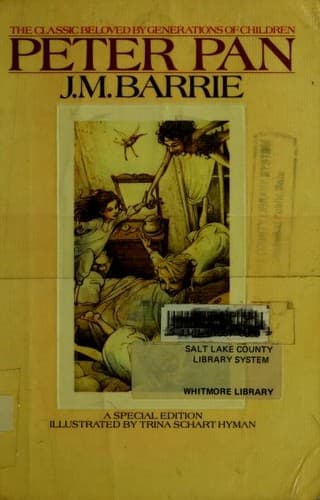
Peter Pan (1911)
About This Book
Wendy, John, and Michael Darling fly to Neverland with Peter Pan, a boy who refuses to grow up, where they encounter mermaids, a tribe of Lost Boys, and the vengeful Captain Hook. The adventure is exhilarating, with sword fights, ticking crocodiles, and flights over moonlit London, but underneath it runs a bittersweet current about the cost of never growing up. It's simultaneously the most joyful and the most melancholy children's book ever written.
Why It's a Classic
J.M. Barrie originally wrote Peter Pan as a play in 1904 before novelizing it, and the theatrical origin shows in the story's vivid set pieces and perfectly timed dramatic moments. Peter is a far more complex character than most adaptations suggest; he is selfish, forgetful, and casually cruel, which Barrie presents not as villainy but as the inevitable result of eternal childhood. The tension between Wendy's desire to grow up and Peter's refusal to do so gives the book an emotional depth that haunts adult readers. Barrie's prose moves between whimsy and genuine darkness with startling ease; Neverland is a place where children can be injured or killed, and the narrator acknowledges this matter-of-factly. The closing pages, in which Wendy grows up and Peter returns for her daughter instead, contain some of the most poignant writing in the English language.
Fun Fact
Barrie donated the copyright to Peter Pan to Great Ormond Street Hospital for Children in London, and the hospital still receives royalties from every production and publication. The character of Captain Hook was not in the original version of the play; Barrie added him after the first production because he felt the story needed a stronger villain. Peter Pan's name comes from Pan, the Greek god of the wild, and Barrie originally introduced the character in an adult novel called The Little White Bird.
Parent Note
The book contains sword fighting, violence, and death; Captain Hook is eaten by a crocodile, and the text mentions children falling to their deaths from the sky if they stop believing they can fly. Peter's casual cruelty and forgetfulness can be unsettling. Barrie's prose is sophisticated and rewards an older reader, making this best for ages 9 and up independently, or as a read-aloud for younger children.
Quick Facts
- Year
- 1911
- Type
- 📚 Book
- Category
- Fantasy / Sci-Fi
- Age Group
- Kids (Ages 7–10)