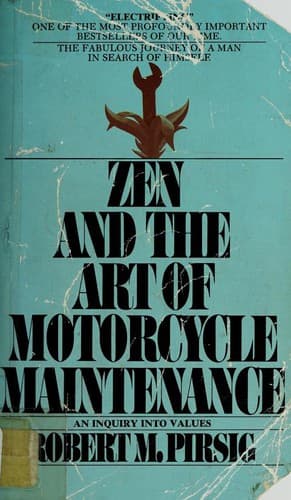
Zen and the Art of Motorcycle Maintenance (1974)
About This Book
A father and son ride a motorcycle across the American West while the narrator, a former university professor who suffered a mental breakdown, uses the maintenance of his motorcycle as a framework for exploring the nature of quality, the divide between classical and romantic understanding, and the question of what makes life worth living. Robert Pirsig wrote a philosophical road trip that became one of the bestselling books of the twentieth century.
Why It's a Classic
Pirsig's central question, 'What is Quality?', sounds simple but opens into a philosophical inquiry that connects motorcycle repair to ancient Greek philosophy, scientific methodology to romantic feeling, and technical skill to moral virtue. His argument that the classical (rational, analytical) and romantic (intuitive, aesthetic) modes of understanding are not opposites but complementary aspects of a single reality was both a critique of the academic philosophy that had driven him to a breakdown and a genuine attempt at synthesis. The motorcycle itself is the book's master metaphor: maintaining a machine properly requires attention, care, and a kind of love that Pirsig calls Quality, and this same attention, applied to any activity, transforms it from mechanical routine into meaningful engagement. The father-son relationship, which is strained by the narrator's history of mental illness and his son Chris's own emerging emotional difficulties, provides an emotional grounding that prevents the philosophy from becoming abstract. The book was rejected by 121 publishers, more than any other bestselling book in history.
Fun Fact
Pirsig received 121 rejections before William Morrow published the book in 1974, and the editor who accepted it told Pirsig that he did not expect it to sell but believed it needed to be published. It went on to sell over five million copies. Pirsig's 'Phaedrus,' the version of himself before the breakdown, was the subject of electroshock therapy that effectively destroyed his previous personality, an experience he describes in the book as being killed. His son Chris, who appears in the book as a child, was murdered in a mugging in San Francisco in 1979 at age twenty-two, a tragedy Pirsig addressed in an afterword to later editions. Pirsig spent four years writing the book while working as a technical writer.
Parent Note
The book describes a mental breakdown and hospitalization, including electroshock therapy, and the narrator's struggle with the knowledge that his previous self was effectively destroyed by psychiatric treatment. The father-son relationship is strained and sometimes painful. There is no violence, sexual content, or strong language. The philosophical sections, which draw on Plato, Aristotle, Kant, and Poincaré, are intellectually demanding but Pirsig explains them clearly. The book is roughly 400 pages. Suitable for readers sixteen and up. A unique blend of memoir, philosophy, and travelogue that rewards rereading.
Quick Facts
- Year
- 1974
- Type
- 📚 Book
- Category
- Philosophy & Ideas
- Age Group
- Adults (Ages 18+)