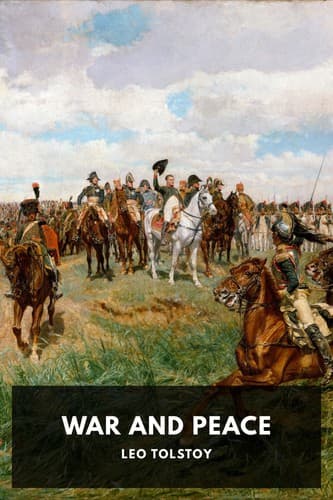
War and Peace (1869)
About This Book
Five aristocratic Russian families navigate love, death, ambition, and spiritual searching against the backdrop of Napoleon's invasion of Russia in 1812, and the novel moves between intimate domestic scenes and vast battlefield panoramas with a fluidity that makes its 1,200 pages feel like a complete representation of human life. Leo Tolstoy wrote what many consider the greatest novel ever written, a work so comprehensive in its vision that it seems to contain the entire world.
Why It's a Classic
Tolstoy's achievement was creating a novel in which the personal and the historical are inseparable: Prince Andrei's battlefield epiphany at Austerlitz, Natasha's first ball, Pierre's search for meaning through Freemasonry and marriage, and the burning of Moscow are all rendered with the same meticulous attention to physical and psychological detail, and the effect is a fictional universe that operates on every scale simultaneously. The battle scenes, particularly Borodino, are the most realistic in literature because Tolstoy insisted on showing war from the soldier's perspective: confusion, smoke, fear, and the impossibility of understanding what is happening even as it happens around you. Natasha Rostova's transformation from an irrepressible teenager to a mature woman is one of fiction's great character arcs, and her near-elopement with Anatole Kuragin is a scene of such emotional intensity that it feels like something the reader is witnessing rather than reading. Tolstoy's philosophical chapters on history, which argue that great men do not shape events but are carried along by forces beyond anyone's control, are either the novel's deepest insights or its most frustrating interruptions, depending on the reader.
Fun Fact
Tolstoy's wife, Sophia, copied the manuscript by hand at least seven times, incorporating his extensive revisions. He originally titled the work '1805' and planned a much shorter book before the scope expanded dramatically. The novel drew on family history: Tolstoy's own relatives fought in the Napoleonic Wars, and several characters are based on family members. The famous first sentence ('All happy families are alike; each unhappy family is unhappy in its own way') actually opens Anna Karenina, not War and Peace, though the two novels are often confused in this regard. War and Peace's actual opening, a conversation at a Petersburg salon conducted partly in French, is deliberately disorienting. Tolstoy later dismissed the novel, saying it was 'not a novel, even less is it a poem, and still less a historical chronicle.'
Parent Note
The novel contains battlefield violence (described realistically, including wounds, amputations, and death), dueling, the burning of Moscow, scenes of imprisonment and near-execution, and the emotional toll of war on families. There is romantic and sexual content, including an attempted elopement and suggestions of adultery. The philosophical digressions on history and free will are intellectually demanding and interrupt the narrative. The novel is roughly 1,200 pages, and the large cast of characters (with Russian patronymics) can be challenging. Translation matters: the Pevear and Volokhonsky translation and the Anthony Briggs translation are both excellent. Suitable for readers sixteen and up with patience for long, complex fiction.
Quick Facts
- Year
- 1869
- Type
- 📚 Book
- Category
- Epics & Foundational Texts
- Age Group
- Adults (Ages 18+)