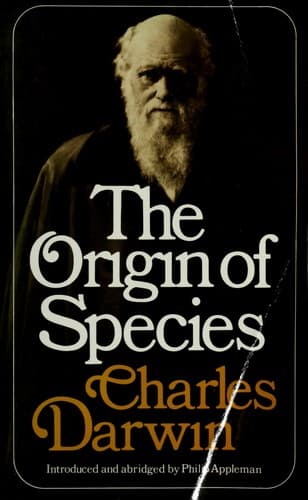
On the Origin of Species (1859)
About This Book
A naturalist who spent five years sailing around the world and twenty more years thinking about what he saw presents the theory that species are not fixed creations but evolve over vast periods of time through a process of natural selection, in which organisms better adapted to their environment survive and reproduce. Charles Darwin wrote the most important scientific book ever published, a work that changed humanity's understanding of its own place in the natural world.
Why It's a Classic
Darwin's achievement was not merely proposing the theory of evolution (others, including his own grandfather, had suggested similar ideas) but supporting it with such an overwhelming accumulation of evidence, drawn from geology, embryology, comparative anatomy, artificial selection, biogeography, and decades of personal observation, that the scientific community was largely convinced within a generation. The prose is remarkably accessible for a scientific text: Darwin writes with a naturalist's eye for vivid detail and a storyteller's instinct for narrative, and his famous 'tangled bank' passage at the end of the book, which describes the complexity and beauty of a patch of ordinary ground, is one of the great passages of English prose. The book's most revolutionary implication, that human beings are part of the same process and share ancestors with all other living things, was one that Darwin himself was reluctant to state explicitly (he reserved it for his later work, The Descent of Man), but it was understood immediately and has been the most contested aspect of the theory ever since.
Fun Fact
Darwin delayed publication for twenty years, partly because he wanted to amass more evidence and partly because he dreaded the religious controversy the theory would provoke. He was finally spurred to publish when Alfred Russel Wallace independently arrived at a nearly identical theory and sent Darwin a manuscript outlining it. The two men's papers were read together at the Linnean Society in 1858, but it was Darwin's book that made the lasting impact. Darwin's wife, Emma, was a devout Christian, and his awareness that his theory contradicted her beliefs caused him genuine anguish. The first edition sold out on its first day of publication, November 24, 1859. Darwin never used the phrase 'survival of the fittest' in the first edition; it was coined by Herbert Spencer, and Darwin adopted it in later editions.
Parent Note
The book contains scientific discussions of variation, inheritance, competition, and extinction. There is no graphic content. The prose is Victorian but clear and often beautiful. The book's implications for religious belief have made it controversial since publication, and readers with strong religious commitments should be aware that Darwin's theory contradicts literal readings of creation accounts. The book is roughly 500 pages and is more readable than most people expect, though some sections on geological evidence are dense. Suitable for readers fifteen and up. Essential reading for understanding modern biology and the history of science.
Quick Facts
- Year
- 1859
- Type
- 📚 Book
- Category
- Philosophy & Ideas
- Age Group
- Adults (Ages 18+)