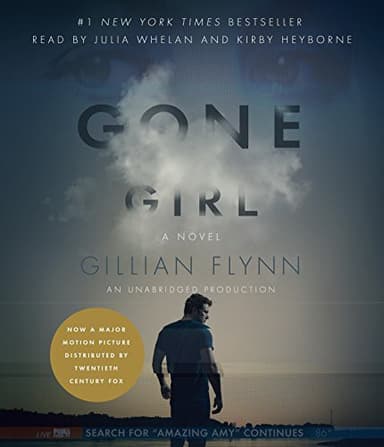
Gone Girl (2012)
About This Book
On the morning of their fifth wedding anniversary, Amy Dunne disappears and suspicion immediately falls on her husband Nick, whose behavior under media scrutiny is suspicious enough to make everyone, including the reader, wonder whether he did it. Then the novel's midpoint twist detonates everything you thought you knew. Gillian Flynn wrote the thriller that redefined the marriage novel for the twenty-first century.
Why It's a Classic
Flynn's structural innovation was using dueling unreliable narrators to make the reader complicit in a manipulation that mirrors the characters' manipulation of each other and of the media. The first half of the novel, which alternates between Nick's present-tense defense and Amy's diary entries, is a masterful exercise in misdirection, and the revelation that arrives at the midpoint does not merely surprise: it forces the reader to reread every preceding chapter with new eyes. Amy Elliott Dunne is one of modern fiction's most memorable creations, a woman whose intelligence, rage, and willingness to destroy herself to punish her husband make her simultaneously terrifying and, in her own twisted way, admirable. Flynn's dissection of modern marriage, media culture, and the performance of identity in a surveillance society gives the thriller a social dimension that elevates it beyond genre. The novel's ending, which refuses to provide the satisfaction of resolution, is its most provocative gesture.
Fun Fact
Flynn was a television critic for Entertainment Weekly before becoming a novelist, and her understanding of media culture and public narrative directly informed the novel's depiction of how the press and social media construct guilt and innocence. The novel spent over a hundred weeks on the New York Times bestseller list. David Fincher's 2014 film adaptation was written by Flynn herself, and she altered the ending slightly from the novel. The phrase 'cool girl,' from Amy's monologue about the pressure women face to perform effortless desirability, entered the cultural lexicon and became one of the most discussed passages in contemporary fiction.
Parent Note
The novel contains graphic violence including descriptions of murder, self-harm staged to mimic assault, a sexual assault, and psychological manipulation between spouses. There is explicit sexual content. Strong language throughout. Themes of misogyny, media manipulation, and the performance of gender roles are handled provocatively. The unreliable narration means the reader's moral footing shifts constantly. Suitable for readers seventeen and up. The novel rewards careful reading and has generated extensive discussion about its gender politics.
Quick Facts
- Year
- 2012
- Type
- 📚 Book
- Category
- Mystery
- Age Group
- Adults (Ages 18+)