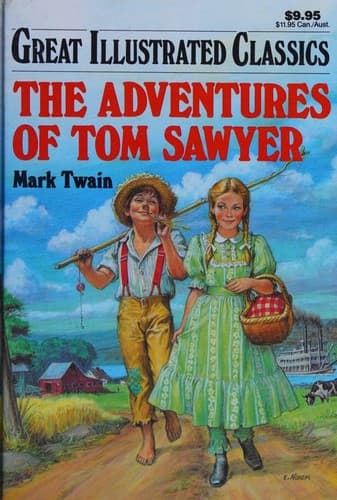
The Adventures of Tom Sawyer (1876)
About This Book
Tom Sawyer is a mischievous, imaginative boy growing up in a sleepy Missouri town along the Mississippi River, where he cons his friends into painting a fence, falls in love with Becky Thatcher, attends his own funeral, and witnesses a murder in a graveyard. Twain writes with infectious delight about the freedom and wildness of boyhood, capturing the way a child's imagination can transform a dusty small town into a kingdom of adventure. Every chapter feels like a new escapade that you wish you had lived yourself.
Why It's a Classic
Mark Twain drew heavily from his own childhood in Hannibal, Missouri, to create the town of St. Petersburg, and that autobiographical foundation gives every scene the texture and warmth of genuine memory. The fence-painting scene is one of the most famous episodes in American literature because it captures something true about human psychology: people want what they cannot have, and the perception of value is as powerful as value itself. Twain's humor is generous and observational rather than cruel, finding comedy in the gap between how children see themselves, as dashing pirates and noble outlaws, and how the adult world actually works around them. The book essentially invented the American childhood adventure story, and its influence can be traced through generations of fiction, from Booth Tarkington to Stand by Me.
Fun Fact
Twain based Tom Sawyer on a combination of three boys he knew growing up in Hannibal, Missouri, and he based Huckleberry Finn on a real boy named Tom Blankenship, the son of the town drunkard. The cave where Tom and Becky get lost in the novel is based on a real cave system near Hannibal called Mark Twain Cave, which is still a tourist attraction today. Twain considered and rejected the idea of following Tom into adulthood, saying it would have meant turning him into a liar, a politician, or something equally awful.
Parent Note
The book includes a murder witnessed by children, scenes in a graveyard, and a genuinely tense sequence where children are lost in a cave. Twain's portrayal of race reflects 1840s Missouri, which is less prominent here than in Huckleberry Finn but still present. The violence is handled in a 19th-century adventure style that most tweens take in stride.
Quick Facts
- Year
- 1876
- Type
- 📚 Book
- Category
- Classics / Literature
- Age Group
- Tweens (Ages 11–13)