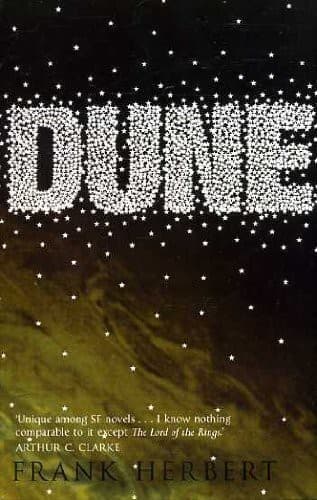
Dune (1965)
About This Book
Fifteen year old Paul Atreides arrives on the desert planet Arrakis, the only source of the most valuable substance in the universe, and is immediately plunged into a war of politics, religion, and survival. The sandworms are terrifying, the desert culture is richly imagined, and the scope of the story is breathtaking. Reading Dune is like stepping into a fully realized civilization that feels as detailed and ancient as our own.
Why It's a Classic
Frank Herbert spent six years researching this novel, studying desert ecology, Middle Eastern history, and psychedelic mushroom cultures, and the result is the most densely layered science fiction world ever built. Every element of Arrakeen society, from the Fremen stillsuits that recycle body moisture to the political economy of spice, is worked out with scientific rigor. Herbert also created a deliberate critique of messianic leadership, showing how Paul's rise to power becomes a trap that threatens to consume him and his people. The novel's ecological themes were decades ahead of their time, portraying a planet where water scarcity drives every aspect of culture and politics. Dune has sold over 20 million copies and directly influenced everything from Star Wars to modern climate fiction.
Fun Fact
Herbert was inspired to write Dune after researching a U.S. Department of Agriculture project to stabilize sand dunes in Florence, Oregon using poverty grasses. He spent six years researching and writing the novel, which was rejected by over twenty publishers before Chilton Books, a company known for publishing auto repair manuals, finally took a chance on it. The book lost money in its first edition.
Parent Note
The novel contains political violence, a scene of attempted assassination by poison, and combat sequences described in a literary rather than graphic style. There are references to drug use through the spice melange, which expands consciousness and is deeply integrated into the world's culture and religion. The prose is dense and demanding, with its own vocabulary and political complexity, so it rewards patient readers. Most teens who love world building and can handle a challenging reading experience will find it deeply rewarding from age 14 up.
Quick Facts
- Year
- 1965
- Type
- 📚 Book
- Category
- Fantasy / Sci-Fi
- Age Group
- Teens (Ages 14–17)