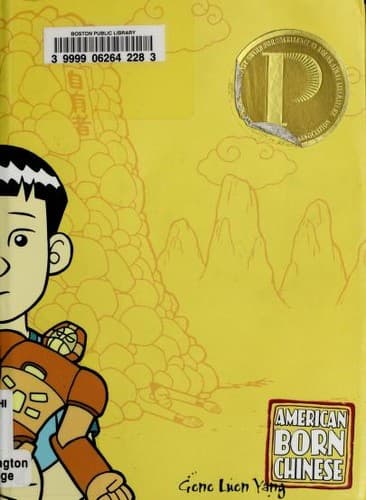
American Born Chinese (2006)
About This Book
Gene Luen Yang weaves together three stories: a Chinese American boy named Jin Wang struggling to fit in at his mostly white school, the legendary Monkey King from Chinese mythology fighting for respect among the gods, and a sitcom style nightmare featuring a grotesque Chinese stereotype named Chin Kee. The three narratives collide in a twist that reframes everything, transforming what seemed like separate stories into a unified meditation on identity, shame, and self acceptance.
Why It's a Classic
Yang took an enormous risk by putting the most offensive Asian stereotypes imaginable on the page through the character of Chin Kee, complete with buckteeth, an accent, and a laugh track, then used the reader's discomfort to make a devastating point about how stereotypes are internalized by the very people they target. The Monkey King sections draw on the classic Chinese novel Journey to the West with gorgeous, dynamic artwork that shifts in style depending on which storyline is being told. Yang was the first graphic novelist to be nominated for a National Book Award, and his win of the Michael L. Printz Award signaled mainstream literary acceptance of the graphic novel form for young adults. The book's three strand structure is intricate and rewarding, revealing its full design only in the final pages.
Fun Fact
Yang originally created the Jin Wang storyline as his MFA thesis project at California State University, then expanded it by adding the Monkey King and Chin Kee narratives. He is also the creator of the graphic novel series Avatar: The Last Airbender and was appointed the Library of Congress's National Ambassador for Young People's Literature in 2016. The book was adapted into a Disney Plus series in 2023 that significantly expanded and altered the original story.
Parent Note
The book depicts racist bullying and stereotyping in ways that are intentionally uncomfortable, including the Chin Kee character whose exaggerated portrayal is designed to critique rather than endorse racism. There is a scene of physical violence and some crude humor. Yang's deliberate use of stereotypes as a narrative device is central to the book's message, and it works best when discussed with context. There is no sexual content or significant profanity. It is appropriate for ages 11 and up.
Quick Facts
- Year
- 2006
- Type
- 📚 Book
- Category
- Graphic Novels / Comics
- Age Group
- Teens (Ages 14–17)